

META TITLE
50/30/20 Budgeting Rule Explained for Beginners.
META DESCRIPTION:
Learn how the 50/30/20 budgeting rule works, what counts as needs and wants, how to calculate each category and how to adapt the rule to your financial situation.
50/30/20 Budgeting Rule Explained for Beginners
Creating a budget can feel complicated when you’re trying to decide exactly how much to spend on groceries, entertainment, bills, savings and everything else.
That’s where the 50/30/20 budgeting rule can provide a simple starting point.
The idea is straightforward: divide your after-tax income into three broad categories:
- 50% for needs
- 30% for wants
- 20% for savings and financial goals
The Consumer Financial Protection Bureau (CFPB) presents the 50/30/20 approach as one budgeting guideline, while also noting that people may need to create a personal rule that fits their own financial circumstances.
If you’re completely new to budgeting, start with our guide on How to Create a Personal Budget When You Don’t Know Where Your Money Goes.
This article will show you how the 50/30/20 rule works, what belongs in each category, how to calculate your numbers and how to adapt the system when the standard percentages don’t fit your life.
What Is the 50/30/20 Budgeting Rule?
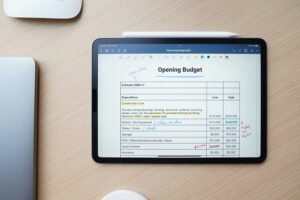
The 50/30/20 budgeting rule is a simple framework for dividing your take-home income into three categories.
50% – Needs
This portion is intended for essential expenses such as:
- Housing
- Basic groceries
- Utilities
- Transportation
- Insurance
- Essential healthcare
- Minimum debt payments
30% – Wants
This category covers things you enjoy but don’t necessarily need to survive.
Examples include:
- Restaurants
- Entertainment
- Streaming services
- Hobbies
- Vacations
- Shopping
- Non-essential subscriptions
20% – Savings and Financial Goals
This portion can go toward goals such as:
- Emergency savings
- Retirement
- Saving for a major purchase
- Education
- Additional debt repayment
- Other financial goals
The exact treatment of debt can vary depending on the version of the framework you’re following , so focus on using the categories as a practical guide rather than treating them as unchangeable rules.
Consumer Financial Protection Bureau – Analyzing Budgets, specifically explains the 50/30/20 approach and emphasizes that it should be adapted to individial circumstances.
Why Use the 50/30/20 Rule?
The biggest advantage of the 50/30/20 budgeting rule is simplicity.
Instead of creating dozens of spending categories, you can begin by looking at three broad areas.
This can help you:
- Understand where your money is going
- Set reasonable spending limits
- Make room for savings
- Identify areas where you’re overspending
- Create a repeatable budgeting routine
A simple system is often easier to maintain than a complicated one.
How Does the 50/30/20 Rule Work?
The rule is generally based on after-tax income or the money you actually have available after taxes and other deductions.
For example, suppose your monthly take-home income is $3,000.
Your starting targets would be:
| Category | Percentage | Example |
| Needs | 50% | $1,500 |
| Wants | 30% | $900 |
| Savings/Goals | 20% | $600 |
| Total | 100% | $3,000 |
These numbers are simply an example.
Your actual percentages may need to look different.
Step 1: Calculate Your Take-Home Income
Before applying the 50/30/20 budgeting rule, determine how much money you actually receive.
If you receive a regular paycheck, use your take-home amount rather than your gross salary.
For example:
Gross salary: $4,000
Taxes and deductions: $800
Take-home income: $3,200
Your budgeting percentages would be based on the $3,200 you actually have available.
If your income changes from month to month, use a realistic average or conservative estimate.
Step 2: Calculate 50% for Your Needs
Once your know your take-home income, calculate approximately half of it.
For example, if your monthly take-home income is $3,000:
$3,000*50% = $1,500
That gives you a starting target of $1,500 for essential expenses.
Needs might include:
- Rent or mortgage
- Electricity
- Water
- Basic groceries
- Transportation
- Insurance
- Phone service
- Essential healthcare
- Minimum required debt payments
The important word here is essential.
What Counts as a Need?
This can sometimes be difficult to determine.
For example, transportation might be a need if you require a vehicle to get to work.
But an expensive vehicle upgrade may be a want rather than a need.
Similarly, groceries are generally a need, while expensive restaurant meals are usually a want.
Ask yourself:
“Would I still need to pay for this if I were trying to reduce my spending significantly?”
If the answer is yes, it may belong in the needs category.
Step 3: Calculate 30% for Wants
The next part of the 50/30/20 budgeting rule is your wants.
If your take-home income is $3,000:
$3,000*30% = $900
That gives you up to $900 for discretionary spending.
Wants can include:
- Dining out
- Entertainment
- Movies
- Hobbies
- Travel
- Streaming services
- Shopping
- Non-essential subscriptions
The purpose isn’t to eliminate these expenses.
It’s to make sure they don’t quietly take over your entire budget.
Why Having a Wants Category Matters?
A budget that doesn’t allow any enjoyment can be difficult to maintain.
If you completely eliminate everything you enjoy, you may eventually become frustrated and abandon your budget.
The wants category gives you some flexibility.
You can spend money on things you enjoy while still keeping your overall finances under control.
The key is staying within an amount that fits your financial situation.
Step 4: Put 20% Toward Savings and Goals
The final part of the 50/30/20 budgeting rule is savings and financial goals.
If your monthly take-home income is $3,000:
$3,000*20% = $600
That $600 could potentially be divided among goals such as:
- Emergency savings
- Retirement
- Education
- Major purchases
- Additional debt repayment
- Other financial goals
You don’t necessarily have to put the entire amount into one goal.
You can divide it according to your priorities.
What If You Can’t Save 20%?
This is where many beginners misunderstand the rule.
If you’re currently unable to save 20%, that doesn’t mean budgeting has failed.
Your housing costs may be high.
You may have debt.
You may have a low or irregular income.
You may be supporting a family.
Your essential expenses may simply consume more than 50% of your income.
The CFPB itself emphasizes that the 50/30/20 approach is a guideline and that people may need to create a spending rule that works for their own circumstances.
So don’t abandon budgeting because your numbers don’t fit perfectly.
Instead, use the framework to identify where your money is going and gradually improve your situation.
What If My Needs Are More Than 50%?
Suppose your monthly take-home income is $3,000, but your essential expenses total $1,900.
That’s about 63% of your income.
Trying to force your needs down to exactly $1,500 may not be realistic.
Instead, you might temporarily use something like:
- 63% needs
- 22% wants
- 15% savings
The percentages are less important than creating a budget you can realistically follow.
Over time, you might look for ways to reduce essential costs or increase income.
What If I Don’t Spend 30% on Wants?
That’s actually fine.
Suppose your wants only total $500 per month.
You don’t need to spend the remaining $400 just because the framework says 30%.
You could redirect some of that money toward:
- Savings
- Debt repayment
- Emergency funds
- A future purchase
- Another financial goal
A budget should guide your money, not encourage you to spend unnecessarily.
50/30/20 Budget Example for a $4,000 Income
Let’s use another example.
Suppose your take-home income is $4,000 per month.
A basic 50/30/20 plan would look like this:
| Category | Percentage | Amount |
| Needs | 50% | $2,000 |
| Wants | 30% | $1,200 |
| Savings/Goals | 20% | $800 |
| Total | 100% | $4,000 |
You could then divide each category into smaller expenses.
Needs – $2,000
- Housing: $1,300
- Groceries: $350
- Utilities: $150
- Transportation: $100
- Insurance: $100
Wants – $1,200
- Dining out: $250
- Entertainment: $150
- Shopping: $200
- Hobbies: $200
- Travel fund: $250
- Subscriptions: $150
Savings/Goals – $800
- Emergency savings: $400
- Retirement: $250
- Other goal: $150
Again, this is only an example. Your own categories will depend on your circumstances.
How to Adapt the Rule to Your Situation?
The best way to use the 50/30/20 budgeting rule is as a starting point.
You can adjust it when necessary.
For example:
1. High housing costs
You might temporarily spend more than 50% on needs.
2. Aggressive savings goal
You might reduce wants and save more than 20%.
3. Paying off significant debt
You may redirect some of the wants category toward debt repayment.
4. Lower income
Your needs may naturally represent a larger percentage of your income.
5. Irregular income
You may need to create your budget using a conservative income estimate.
Your budget should reflect reality.
The 50/30/20 Rule Isn’t a Perfect Formula
One of the biggest mistakes is treating the rule as a mathematical requirement.
It’s better to think of it as a framework.
Your financial situation may be completely different from someone else’s.
Two people earning the same income can have very different:
- Housing costs
- Family responsibilities
- Transportation needs
- Debt levels
- Financial goals
- Savings priorities
So don’t compare your percentages with someone else’s and assume you’re doing something wrong.
Common Mistakes When Using the 50/30/20 Rule
Mistake 1: Using Gross Income
The framework is generally applied to take-home income.
Mistake 2: Treating Every Expense as a Need
Some expenses may feel necessary simply because you’re used to having them.
Mistake 3: Spending the Full 30% on Wants
Thirty percent is not a spending target you have to reach.
Mistake 4: Giving Up When Your Numbers Don’t Fit
Your circumstances may require a different percentage split.
Mistake 5: Forgetting Irregular Expenses
Annual bills and occasional expenses still need to be planned for.
How to Make the 50/30/20 Rule Easier to Follow?
You don’t need to check your percentages every time you buy something.
Instead:
- Calculate your monthly take-home income.
- Estimate you three major categories.
- Track your actual spending.
- Compare your spending with your plan.
- Adjust where necessary.
- Review the budget each month.
If you’re consistently spending too much on wants, look for one or two categories to reduce.
If your savings percentage is too low, start with a smaller increase rather than making an unrealistic change.
Use the Rule as a Guide, Not a Judgment
Your financial situation isn’t a measure of your personal worth.
If your current budget doesn’t look like 50/30/20, that doesn’t mean you’re bad with money.
The purpose of the framework is to help you understand your choices.
May be your current split is:
- 65% needs
- 20% wants
- 15% savings
That’s still useful information.
Now you know where you stand and can decide what you’d like to change.
A Simple 50/30/20 Checklist
Before finishing your budget, ask:
- Have I calculated my take-home income?
- Have I identified my essential expenses?
- Have I seperated needs from wants?
- Am I setting aside money for savings or financial goals?
- Are my percentages realistic?
- Have I included irregular expenses?
- Am I tracking my actual spending?
- Can I adjust the categories if my circumstances change?
If you can answer these questions, you have a useful starting point.
Conclusion
The 50/30/20 budgeting rule is a simple framework for organizing your money into needs, wants and savings or financial goals.
Its biggest advantage is that it makes budgeting easier to understand.
But remember: 50/30/20 is a guideline, not a requirement.
If your needs currently take up more than 50% of your income, don’t assume you’ve failed. If you can save more than 20%, you don’t have to spend the difference. And if your wants are below 30%, that’s perfectly fine.
The goal is to create a spending plan that reflects your actual financial situation and helps you move toward your goals.
Once you understand your current spending pattern, you can start making intentional decisions about where your money should go.
FAQs
1. What is the 50/30/20 budgeting rule?
The 50/30/20 rule is a simple framework that generally allocates 50% of take-home income to needs, 30% to wants and 20% to savings and financial goals.
2. Is the 50/30/20 rule realistic for everyone?
No. It is a guideline rather than a universal rule. Housing costs, income, debt, family responsibilities and financial goals can make a different percentage split more realistic.
3. Does the 50/30/20 rule include debt?
Different versions of the framework handle debt differently. Some include minimum debt payments with needs and additional debt repayment with savings or financial goals. The important thing is to account for your debt payments somewhere in your overall plan.
4. What if I cannot save 20% of my income?
Start with a smaller percentage that is realistic for your financial situation. Even saving a small amount regularly is better than not saving at all.
5. Should I use gross or net income for the 50/30/20 rule?
The framework is generally based on after-tax or take-home income, the money you actually have available to spend and save.
6. Are groceries needs or wants?
Basic groceries are considered needs. However, expensive restaurant meals, frequent takeout and luxury food purchases may fall under wants.
7. What if my needs are more than 50%?
Don’t force your budget to fit the rule. Use your actual numbers and look for realistic ways to reduce costs or increase income over time.
8. Does the 20% include debt repayment?
Yes. The 20% category can include extra debt payments, savings, investments and contributions toward financial goals. Minimum required debt payments are often treated as part of essential expenses.
9. Can I save more than 20%?
Yes. If your essential expenses and wants are below the suggested percentages, you can direct more money toward savings, investing, debt repayment or other financial goals.
Good way to be financially aware. I will follow 50/30/20 idea, sounds pretty promising.
Thanks a lot Shyam.